
Understanding Omni-Directional Wheels in VEX IQ: The Engineering Principle Behind Competitive Precision


In competitive robotics, outcomes are often determined not by dramatic mechanical innovations but by the precise execution of fundamental design decisions. Among these, the selection and configuration of a drivetrain's wheel system plays a critical role in a robot's ability to navigate, position, and perform under time constraints.
The omni-directional wheel — a component that appears deceptively simple — is one such design decision. In the VEX IQ platform, understanding how these wheels function and why they matter represents a meaningful step in a young engineer's development: the moment abstract physics becomes tangible, testable, and directly tied to competitive results.

The Mechanical Design of an Omni-Directional Wheel
An omni-directional wheel is distinguished from a conventional wheel by one structural addition: a series of small, barrel-shaped rollers mounted around the outer circumference, oriented perpendicular to the wheel's primary axis of rotation.
A standard wheel provides motion in a single axis — forward and backward, driven by the motor. Any lateral force applied during turning causes the wheel to scrub against the surface, generating friction, reducing positional accuracy, and introducing unpredictable behaviour into the robot's movement path.
The omni-directional wheel addresses this limitation directly. The motor-driven rotation propels the robot forward and backward as expected. However, the perpendicular rollers — which spin freely and independently of the motor — allow the wheel to translate laterally with minimal resistance. In effect, the wheel operates across two axes of motion simultaneously: one powered, one passive.

Holonomic Motion: How Four Omni Wheels Create Three Degrees of Freedom
When four omni-directional wheels are arranged in a carefully calculated configuration — typically with each wheel angled at 45 degrees relative to the chassis — they produce what engineers refer to as holonomic motion. This is the ability of a platform to move independently along three degrees of freedom on a two-dimensional surface: translation along the X-axis, translation along the Y-axis, and rotation about the vertical axis.
In practical terms, a holonomic drivetrain allows a VEX IQ robot to move forward, backward, sideways, and diagonally — all while simultaneously rotating — without requiring any change in the robot's physical orientation. This is a significant mechanical advantage over a conventional differential drive system, which can only move forward or backward and must rotate its entire chassis to change direction.
For young engineers learning to program autonomous routines, this translates into a critical benefit: the robot's actual movement closely matches the intended movement described in their code. Positional drift is minimised, turn accuracy improves, and the gap between what the code instructs and what the robot executes narrows considerably.
Comparative Analysis: Conventional Wheels vs. Omni-Directional Wheels
Understanding the trade-offs between these two drivetrain configurations is an essential part of engineering education.
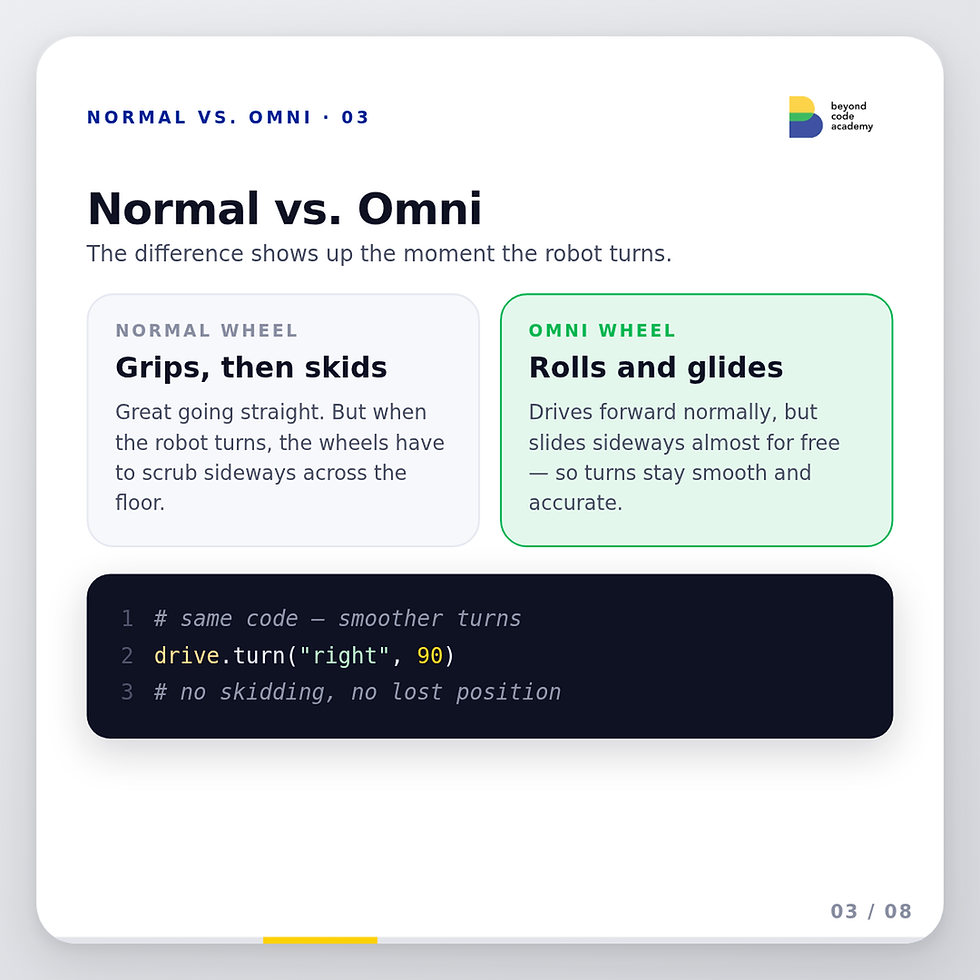
A conventional differential drive uses two powered wheels and one passive caster wheel. It is straightforward to build and program, making it an appropriate starting point for beginners. The robot moves forward and backward reliably, and turning is achieved by varying the speed of each powered wheel. However, the system is limited to two degrees of freedom (forward/backward and rotation), and lateral movement is not possible without first rotating the chassis. During turns, the powered wheels scrub against the surface, introducing friction and positional error.
An omni-directional drive uses four powered wheels with perpendicular rollers. It requires marginally more complex programming — each of the four motors must be controlled independently to achieve the desired direction and rotation — but the return on that complexity is substantial. The robot gains full holonomic motion, enabling lateral translation, diagonal movement, and simultaneous rotation. Turning is smoother and faster because the passive rollers eliminate scrubbing friction entirely.
At Beyond Code Academy, young engineers work with both configurations in sequence. They begin with a differential drive to build foundational understanding of motor control and directional logic, then transition to an omni-directional system. This comparative approach ensures they grasp the engineering trade-offs — not merely how to build with omni wheels, but why they are advantageous in specific contexts.

Competitive Implications in VEX IQ Tournaments
In VEX IQ competition environments, robots operate under strict time constraints — typically completing autonomous and driver-controlled tasks within 60-second match windows. Precision, speed, and repeatability are not abstract goals; they are the measurable factors that determine match outcomes.
Omni-directional wheels provide a quantifiable competitive advantage across several dimensions. Turns execute more rapidly because the elimination of scrubbing friction reduces the time and energy required for directional changes. Positional accuracy improves because the robot can approach objects and scoring zones from any angle without requiring wide arcing manoeuvres — it can translate laterally into the correct position. Most significantly, autonomous routines become more reliable: because the robot's movement is mechanically consistent across repeated runs, the same code produces the same path each time. This repeatability is often the decisive factor in closely contested matches.
The programming itself also benefits from the mechanical precision of the drivetrain. Because the wheels handle directional transitions cleanly, the code required to control movement is often more intuitive and less burdened by compensatory logic for drift and positional error. Young engineers spend less time debugging movement anomalies and more time developing strategic solutions to the competition challenge itself.

Conclusion
The omni-directional wheel is a compelling example of how a single, well-considered design detail can fundamentally alter a robot's capabilities. For young engineers, understanding this component is not merely about mechanical assembly — it is an exercise in applied physics, systems thinking, and evidence-based design decision-making.
VEX IQ Robotics remains one of the most effective platforms for introducing young engineers aged 9 and above to these principles in a hands-on, competition-driven context. At Beyond Code Academy, our VEX IQ Robotics programme is designed to develop not just technical competence, but the engineering mindset that underpins it: curiosity, precision, and the confidence to iterate.



Comments